Picture this: a production line is ready to run. However, the operator cannot confirm if enough raw material exists in stock to complete the batch. Someone gets sent to physically check the storage racks. Twenty minutes later, production is still waiting. This happens not because the material is missing, but because no one could confirm its presence without walking the floor.
This scenario plays out daily in manufacturing facilities that still rely on manual inventory tracking, spreadsheets, or disconnected systems. As production schedules get tighter and customer lead-time expectations shrink, these small delays add up to real money.
A warehouse management system for manufacturing gives production, warehouse, and procurement teams a shared, real-time view of raw materials, work-in-progress (WIP) components, and finished goods. Consequently, this closes the visibility gap that causes so many avoidable delays.
In this article, we will walk through the specific warehouse challenges manufacturers face. Furthermore, we will explain why traditional processes break down as production scales and how a purpose-built system like OneWMS addresses these problems from receiving through shipping.
Warehouse Challenges in the Manufacturing Industry
Manufacturing warehouses handle a complex flow of goods. Teams must track raw materials, components, work-in-progress, and finished goods simultaneously across receiving docks, production floors, and storage areas. A few common pain points show up repeatedly:
- Inaccurate Raw Material Inventory: When material counts in the system do not match shelf stock, production planners lose trust in the data. Therefore, this issue leads to unnecessary rush orders or unplanned downtime.
- Stockouts That Halt Production: Running out of a critical component mid-run does not just delay one order. Instead, it cascades into missed delivery windows for multiple downstream customers.
- Overstocking and Tied-Up Capital: Without visibility into actual usage rates, procurement teams often over-order to stay safe. As a result, excess raw materials tie up working capital and raise storage costs.
- Manual Encoding Errors: Hand-written logs and spreadsheet entries lead to typos, duplicates, and missed entries. This risk increases significantly during high-volume receiving days.
- Slow Order Fulfillment for Finished Goods: Shipping teams waste time searching for the right pallet when records fall out of sync. Consequently, outbound shipments face delays.
- Poor Warehouse Visibility Across Shifts: Without real-time data, night shifts do not know what day shifts picked or moved. Thus, duplicate work and confusion occur frequently.
- High Labor Costs from Manual Searching: Research from the MHI Annual Industry Report shows that workforce challenges remain a top pressure point for operators. Time lost to manual searching adds directly to that labor burden.
- Shipping Delays from Inventory Discrepancies: When the system displays available stock that is physically missing, staff must pause to investigate. Ultimately, this hurts on-time delivery rates.
Why Traditional Warehouse Processes No Longer Work
Many manufacturers start with spreadsheets, whiteboards, or basic accounting software to track inventory. For a small operation, that approach works for a while. However, as production volume, SKU count, and order complexity grow, traditional methods break down:
- No Real-Time Updates: Spreadsheets only reflect inventory from the last manual update rather than current floor reality.
- No Single Source of Truth: When procurement, production, and shipping keep separate records, discrepancies are inevitable.
- Inability to Guide Multi-Step Workflows: Static sheets cannot direct a receiving clerk, picker, or packer through a connected process.
- Difficulty in Scaling: Adding new product lines or warehouses multiplies the manual reconciliation needed to maintain accuracy.
- Lack of Audit Trails: When issues arise, tracing where an inventory discrepancy occurred becomes nearly impossible.
This pattern explains why growing manufacturers eventually adopt software built for warehouse operations rather than general tools. Indeed, industry standards highlighted by the Association for Supply Chain Management (ASCM) emphasize digital inventory control as a core driver of operational resilience.
How OneWMS Solves These Challenges
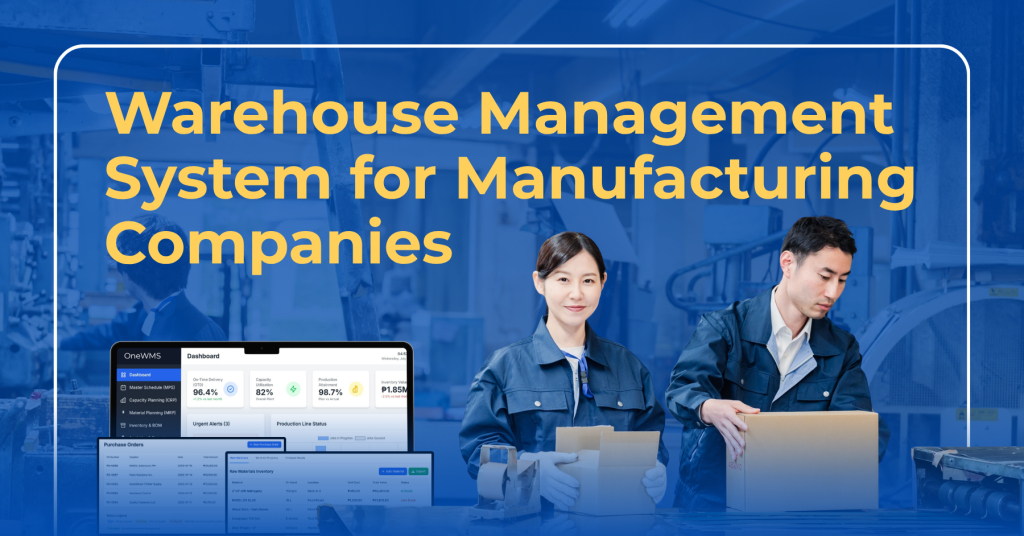
OneWMS, developed by OnePHP Technology, gives manufacturers a connected, real-time view of inventory from receiving through shipping. Here is how its core features translate into practical outcomes on the floor.
Real-Time Inventory Tracking
- Feature: The system updates inventory counts automatically as staff receive, move, or consume materials.
- Benefit: Production planners always see current, accurate stock levels.
- Business Outcome: Fewer unplanned production stoppages occur from hidden material shortages.
Barcode Scanning
- Feature: Barcode-guided receiving, putaway, and picking replace manual entry.
- Benefit: This technology reduces human error at each handoff point.
- Business Outcome: Mismatched counts decrease, saving time on discrepancy investigations.
Warehouse Visibility
- Feature: A centralized dashboard shows inventory location, quantity, and status across the facility.
- Benefit: Authorized team members check material availability without walking the floor.
- Business Outcome: Decision-making for production scheduling and procurement accelerates.
Receiving Management
- Feature: Staff verify inbound shipments against purchase orders directly in the system.
- Benefit: The system flags discrepancies between ordered and arrived items instantly.
- Business Outcome: Fewer surprises happen when pulling materials for production.
Picking Optimization
- Feature: Guided picking paths direct staff to components and finished goods efficiently.
- Benefit: Workers spend less time walking and searching.
- Business Outcome: Turnaround time from order to shipment improves.
Packing Accuracy
- Feature: The system verifies packed orders against picked items before shipping.
- Benefit: Mis-shipments and costly returns drop significantly.
- Business Outcome: Higher order accuracy leads to fewer customer complaints.
Stock Transfers
- Feature: OneWMS tracks material movement between storage zones and production areas with a complete audit trail.
- Benefit: Operations gain full visibility into material locations at any moment.
- Business Outcome: Incidents of lost inventory decrease, enabling faster root-cause analysis.
Reporting Dashboards
- Feature: Real-time reports display inventory levels, order status, and warehouse activity.
- Benefit: Managers spot trends, such as recurring component shortages, before problems arise.
- Business Outcome: Procurement and planning decisions become more proactive and data-driven.
Multi-Location Inventory
- Feature: Track inventory across multiple warehouses or production facilities from a single platform.
- Benefit: Centralized visibility supports manufacturers with distributed operations.
- Business Outcome: Teams balance stock across locations instead of over-ordering at each site.
User Access Controls
- Feature: Role-based permissions control who views, edits, or approves inventory transactions.
- Benefit: Unauthorized changes to inventory records drop significantly.
- Business Outcome: The facility gains a secure inventory system with a clear audit trail.
Benefits of OneWMS for Manufacturing
Labor remains one of the largest controllable costs in any warehouse. Employment data from the U.S. Bureau of Labor Statistics (BLS) on warehousing and storage underscores why eliminating manual, error-prone tasks impacts your bottom line directly:
- Faster Warehouse Operations: Guided workflows reduce time spent on receiving, picking, and packing.
- Better Inventory Accuracy: Real-time, barcode-verified data replaces manual counts.
- Lower Operating Costs: Less labor gets wasted searching for materials or correcting errors.
- Improved Customer Satisfaction: Shipments arrive on time and accurately more consistently.
- Increased Productivity: Staff spend more time on value-added tasks instead of manual reconciliation.
- Reduced Human Error: Barcode scanning catches mistakes before they compound.
- Better Decision-Making: Real-time reporting gives production and procurement teams actionable data.
Example Business Scenario
Consider a mid-sized manufacturer producing custom metal components for industrial equipment. Before implementing a WMS, the company relied on a shared spreadsheet updated manually at the end of each shift.
The Problem
Production planners frequently discovered material shortages only after starting a job. Consequently, this forced rush orders from suppliers at premium prices. Meanwhile, finished goods sat in wrong storage zones, causing shipping delays of a day or more.
The Solution with OneWMS
- Real-Time Counts: Raw material levels became visible instantly. Thus, planners confirmed material availability before scheduling a run.
- Barcode-Guided Receiving: Data entry errors dropped, which improved the accuracy of incoming material records.
- Finished Goods Tracking: Shipping teams gained clear locations for every pallet, cutting search time before outbound shipments.
- Reporting Dashboards: Procurement identified recurring stock drops proactively, adjusting reorder points before shortages occurred.
While every implementation varies by facility size, this scenario reflects a common pattern. The core problem is rarely a lack of team effort; rather, it stems from a lack of real-time, reliable data.
Can You Relate to Any of These Daily Operational Struggles?
If these scenarios sound all too familiar, manual processes and disconnected systems are likely holding your operations back:
- The Constant Hunt: Your warehouse or production staff waste hours every week walking the floor just to physically confirm if a raw material or finished product is actually on the shelf.
- Mid-Production Surprises: A job is set up and scheduled, only for workers to discover mid-run that a key component is missing—forcing immediate, unplanned downtime.
- The Spreadsheet Gap: Your physical counts almost never match what’s written on paper or entered into Excel, making stock audits a stressful guessing game.
- Fulfillment Bottlenecks: Receiving inbound shipments or picking outbound orders takes twice as long as it should because everything relies on manual logbooks and human memory.
- Growing Pains: As your order volume, shifts, or storage zones expand, keeping track of what moved where feels increasingly chaotic and untraceable.
If you caught yourself nodding along to two or more of these points, your business has outgrown manual tracking. Exploring a purpose-built Warehouse Management System (WMS) is the logical next step to reclaim control, cut labor waste, and protect your bottom line.
Frequently Asked Questions
What is a warehouse management system for manufacturing?
A manufacturing WMS is specialized software that tracks raw materials, work-in-progress components, and finished goods in real time. It covers receiving, storage, picking, packing, and shipping across the facility.
How does a WMS help with raw material tracking?
The software updates material counts automatically as staff receive, move, or consume items. Thus, planners gain accurate visibility instead of relying on manual counts or spreadsheets.
Can a WMS integrate with existing ERP or production planning software?
Yes. Modern platforms like OneWMS work alongside existing business systems. They feed accurate warehouse data into ERP or production planning tools rather than operating in isolation.
Does a manufacturing WMS help reduce production downtime?
Indeed it does. By giving planners real-time visibility into material availability, a WMS prevents unplanned stoppages caused by mid-run shortages.
Is a warehouse management system only useful for large manufacturers?
No. Small and mid-sized manufacturers see significant benefits as well. This holds especially true once manual tracking creates frequent errors, delays, or lost search time.
How long does it take to implement a WMS in a manufacturing facility?
Timelines vary based on facility size and complexity. However, vendors design purpose-built systems for a faster rollout than broad enterprise software deployments.
What is the difference between a WMS and an MRP system?
An MRP system plans which materials are needed and when. Conversely, a WMS focuses on physical execution by tracking, storing, and moving inventory accurately inside the facility.
Can a WMS track inventory across multiple manufacturing plants?
Yes. Systems like OneWMS support multi-location inventory tracking, offering a centralized view of stock across all facilities.
Conclusion
Manufacturing warehouses carry high complexity. Raw materials, work-in-progress, and finished goods must move accurately to keep production on schedule. When visibility is missing, costs appear as stalled production lines, rush orders, and delayed shipments.
A warehouse management system closes that gap by giving your team a real-time, accurate view of inventory at every stage. In short, it replaces manual guesswork with reliable data your team can trust.
If these operational challenges sound familiar, it may be time to see what a purpose-built WMS can do for your facility.