In the high-velocity Philippine market of 2026, your warehouse is either the engine of your growth or the anchor dragging you down. However, many business owners don’t realize their facility is failing until the “Out of Stock” emails start flooding in and customer churn begins to spike.
The primary culprit is rarely a lack of space or a lack of staff. Instead, it is almost always “Infrastructure Drag”—the friction caused by manual processes, paper trail dependency, and human error. Consequently, a modern Warehouse Management System (WMS) has evolved from a luxury for giants into a survival tool for SMEs.
Let’s dissect the specific, industry-ending nightmares that occur when you manage a warehouse by “gut feel” rather than data.
1. E-Commerce: The “Ghost Inventory” Nightmare
The Scenario: It’s 11:11, and your TikTok Shop is booming. Your dashboard shows 50 units of a viral skincare product. However, when your pickers head to the racks, they find only 12 units. The rest? They were sold yesterday on Shopee but never “subtracted” from your total count.
The Issue: This is “Ghost Inventory.” Furthermore, it leads to the most expensive mistake in retail: the cancelled order. In 2026, platforms penalize your seller rating for every stock-out cancellation. As a result, you lose visibility, your ads become more expensive, and your brand trust erodes.
The WMS Solution: By integrating a real-time multi-channel inventory sync, a WMS acts as the single source of truth. When a sale happens on any platform, the system “locks” that stock instantly across all other channels.
- The Result: You never sell a “ghost” again. Therefore, your shop rating stays at 5 stars, and you maximize every single marketing peso.
2. Food & Beverage: The “Expired Profits” Disaster
The Scenario: You walk through your cold storage and find three pallets of premium yogurt that expired yesterday. In contrast, the “fresh” batch you received this morning is already being loaded onto delivery trucks.
The Issue: This is a failure of rotation. Essentially, manual warehouses often operate on a “LIFO” (Last In, First Out) basis because staff naturally grab whatever is closest to the door. Consequently, older products get pushed to the back of the rack until they become “dead stock.” In the F&B world, expired stock is literally cash thrown into the trash.
The WMS Solution: A WMS enforces FEFO (First Expired, First Out) protocols. Furthermore, the system generates “Pick Tasks” that direct the staff to the specific slot containing the oldest viable product.
- The Result: You slash your waste by up to 40%. Finally, your inventory turns faster, and your customers always receive the freshest possible goods.
3. Pharmaceuticals: The “Recall Anxiety” Crisis
The Scenario: A laboratory notifies you that “Batch #902-X” of a common cough syrup must be recalled immediately due to a labeling error. You have 4,000 bottles somewhere in your supply chain. Can you find them in the next 60 minutes?
The Issue: In a manual warehouse, tracking lot numbers is a paperwork nightmare. Consequently, if a recall happens, you might have to pull all your stock because you can’t prove which bottles are safe. Moreover, failing to track batch numbers puts you at high risk for regulatory non-compliance.
The WMS Solution: Every item is scanned into the system with its batch and expiry data attached. As a result, a single search query in your WMS tells you exactly which rack the bottles are on, which trucks they are currently loaded on, and which customers already bought them.
- The Result: You turn a potential legal disaster into a 15-minute administrative task. Therefore, your business remains a trusted partner in the healthcare ecosystem.
4. Construction & Hardware: The “Worker Downtime” Bottleneck
The Scenario: Your construction crew is on-site at a major Mandaluyong development. They are ready to pour concrete, but they are missing the specialized chemical hardener. Back at the warehouse, three people are frantically searching through 2,000 square meters of steel and timber to find one small pallet.
The Issue: This is “Search Time.” In large-scale hardware distribution, “we know it’s in here somewhere” is a phrase that costs thousands of pesos in labor downtime. Furthermore, poor “slotting”—where heavy items are placed too far from the loading dock—causes physical fatigue and slows down your entire fleet.
The WMS Solution: A WMS uses Precision Slotting and Heat Mapping. Essentially, it analyzes which items move the most and places them in “Golden Zones” near the shipping doors.
- The Result: Your “Pick-to-Ship” time drops by 50%. In addition, your site crews stay productive because the materials they need arrive on time, every time.
5. 3PL & Third-Party Fulfillment: The “Billing Leakage” Hole
The Scenario: You manage a warehouse for ten different clients. At the end of the month, your accountant spends three days trying to calculate how many pallets each client used and how many “picks” were performed for their orders.
The Issue: This is “Billing Leakage.” Moreover, if you are guessing your storage costs, you are likely under-billing your clients and eating the overhead yourself. Manual tracking cannot accurately capture the complexity of multi-client fulfillment.
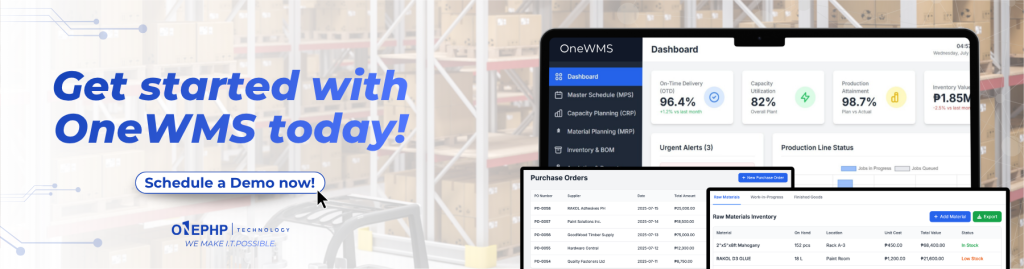
The WMS Solution: Modern WMS platforms like OneWMS include automated 3PL Billing Modules. Therefore, every time a pallet is moved or a box is packed, the system logs it under the correct client account.
- The Result: Your end-of-month billing takes five minutes instead of three days. Consequently, your cash flow improves, and your clients trust your transparency.
6. Manufacturing: The “Just-in-Case” Inventory Trap
The Scenario: You have so much raw material that you’ve run out of space for finished goods. However, you realize you have six months’ worth of a component you only need once a month, but you are out of the one component you need for today’s production run.
The Issue: This is “Just-in-Case” hoarding. Because you don’t have real-time visibility, you over-order “just in case” you run out. This ties up your capital in stagnant stock.
The WMS Solution: By integrating your warehouse with production planning software, you move toward a Just-In-Time (JIT) model. The system tells you exactly when to reorder based on real-time consumption.
- The Result: You free up capital that was previously “sitting on a shelf.” Essentially, you become leaner, faster, and more profitable.
Making I.T. Possible for Your Logistics
Whether you are dealing with “Ghost Inventory” or “Recall Anxiety,” the solution remains the same: you must digitize your backbone. In 2026, the speed of business is the speed of your warehouse. By removing the manual friction that causes these nightmares, you empower your team to focus on growth rather than searching for missing boxes.
Is your warehouse ready for the 2026 demand? Don’t let these “Silent Profit Killers” stay in your facility. It is time to transition to a system built for the precision and scale of the modern Philippine market.
👉 Schedule a meeting now with OnePHP Technology to audit your current warehouse flow and discover how OneWMS can turn your logistics into your greatest competitive advantage.