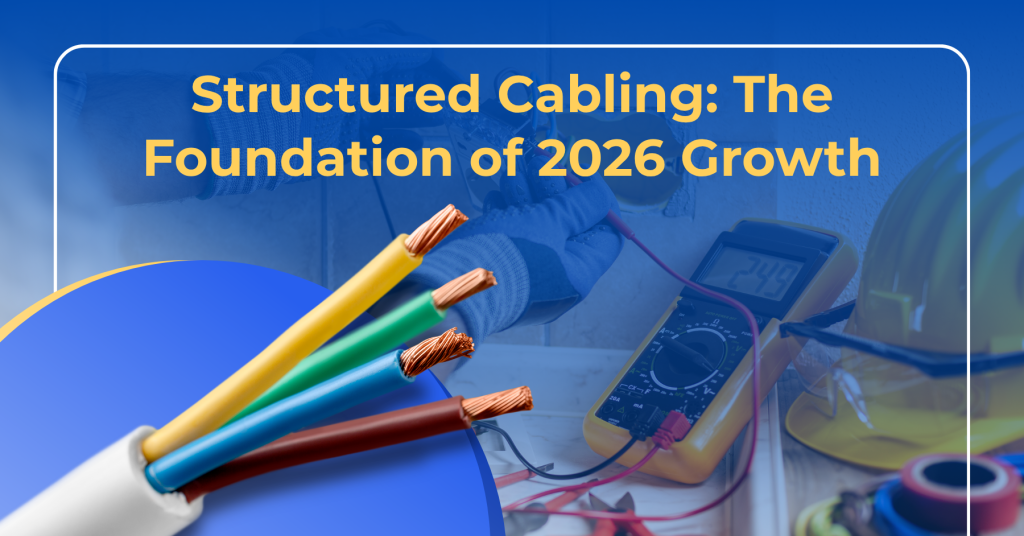
In the modern business hubs of BGC, Makati, and Ortigas, companies are investing millions in AI-driven software, high-speed cloud services, and real-time data analytics. However, many of these businesses are building their digital empires on a foundation of sand—or more accurately, a foundation of “spaghetti” wiring.
Structured cabling is the unsung hero of the digital age. It is the comprehensive system of cabling and associated hardware that provides a complete telecommunications infrastructure. When done correctly, you don’t think about it. When done poorly, it becomes the single biggest bottleneck in your company’s growth.
1. The Chaos of “Point-to-Point” vs. The Order of “Structured”
To understand why you need structured cabling, you must first understand the alternative: Point-to-Point (P2P). In a P2P setup, you run a cable directly from a server to a computer. If you add ten more computers, you run ten more cables.
The Reality of the “Spaghetti” Room
Eventually, this leads to a “spaghetti” server room. This isn’t just an aesthetic issue; it’s a functional disaster:
- Airflow Blockage: Dense, tangled cables block the exhaust of your servers, leading to overheating and hardware failure.
- Signal Interference (Crosstalk): When data cables are bundled haphazardly, the electrical signals bleed into each other, causing “noise” that slows down your internet speeds.
- Impossible Troubleshooting: When a single workstation loses connection, your IT team has to manually trace a cable through a mountain of tangled wires. That’s hours of lost productivity.
The Structured Fix: By using patch panels and standardized trunking, every cable is labeled and organized. It turns your server room from a maze into a library.
2. Future-Proofing for 2026 and Beyond
We are living in an era of 10-Gigabit speeds and Power over Ethernet (PoE). Your cabling from five years ago likely wasn’t built for the power-hungry devices of today.
Bandwidth Evolution
If you are still running Cat5e, you are effectively driving a Ferrari in a school zone. Structured cabling allows you to upgrade your backbone without tearing out your entire infrastructure:
- Cat6 & Cat6a: The current gold standard for local office networks, supporting 10Gbps at shorter distances.
- Fiber Optic Backbones: For businesses occupying multiple floors or large warehouses, fiber is non-negotiable for high-speed data transmission without signal loss.
According to the Telecommunications Industry Association (TIA), standardized cabling infrastructure is designed to last 15 to 20 years—far longer than the computers or switches attached to it. Investing in high-quality copper and fiber now saves you from a massive “rip-and-replace” project in 2028.
3. The “Silent” Savings: Lowering Your TCO
Many business owners view structured cabling as a “sunk cost.” In reality, it offers a massive Total Cost of Ownership (TCO) advantage.
Reducing Downtime Costs
In a professional environment, every minute of downtime costs money. If your network goes down because of a loose, unlabelled cable, you are paying for:
- Staff Downtime: 50 employees sitting idle.
- IT Labor: Expensive hours spent “tracing” instead of “fixing.”
- Opportunity Cost: Lost sales or missed client deadlines.
With structured cabling, fault isolation takes minutes. You can unplug a single patch cord and test the line instantly. The organization alone can reduce your network-related downtime by up to 40%.
4. Supporting the “Smart Office” Ecosystem
Structured cabling isn’t just for desktop PCs anymore. In 2026, it is the nervous system for your entire “Smart” ecosystem:
- IP Surveillance: High-definition cameras require stable, high-bandwidth connections to prevent “frame dropping” in your security footage.
- Wi-Fi 6E/7 Access Points: These latest wireless standards require multiple high-speed cable runs to each access point to deliver their promised speeds.
- Smart Lighting & HVAC: Power over Ethernet (PoE) now allows your network cables to power your lights and climate sensors, bringing your office into the “Green Tech” era.
5. Safety, Compliance, and Professionalism
There is a legal reality to cabling that often gets ignored. Professional installation ensures you are compliant with the National Building Code of the Philippines and fire safety standards.
- Plenum-Rated Cables: In a fire, cheap cable jackets release toxic smoke. Professional structured cabling uses “Plenum-rated” materials in air-handling spaces to ensure safety.
- Documentation: A professional job comes with a Digital Map. You get a floor plan showing exactly where every “drop” is located, making your next office move or expansion a breeze.
The OnePHP Reality Check: A Cabling Audit
Does your current infrastructure pass the test? Ask your IT team these three questions:
- “Do we have an up-to-date cable map for this office?”
- “When was the last time we tested our signal-to-noise ratio?”
- “Is our server room temperature rising because of cable congestion?”
At OnePHP Technology, we don’t just see wires; we see the lifeline of your business. We provide end-to-end infrastructure solutions—from the initial site survey and design to the final labeling and certification. Whether you are setting up a new warehouse in Laguna or a tech-startup office in Pasig, we ensure your physical foundation is as advanced as your software.
Your software is 2026. Make sure your wiring isn’t stuck in 2010.
Ready to stabilize your network?
Stop letting a messy server room dictate your company’s speed. Let’s build a foundation that lasts.
🔗 Book a Professional Infrastructure Audit with OnePHP Technology Today