It’s cut-off day again. You’re staring at a spreadsheet, asking yourself the same two questions: Is the computation right? Are the deductions updated?
If that sounds familiar, you’re not alone. Many Philippine businesses still run payroll by hand, and it takes more out of your team than it seems. In this post, we’ll look at where the cost comes from and how payroll software in the Philippines can take it off your plate.
Why Manual Payroll Costs More Than You Think
Manual payroll rarely fails in one big moment. It chips away a little more at every cut-off:
- Time. Collecting attendance, computing late, undertime, and overtime, and double-checking everything takes hours.
- Mistakes. One wrong formula or outdated rate can throw off the whole payroll. Then come the corrections, the re-releases, and the unhappy employees.
- Compliance worries. Contribution tables and tax rules change, and it’s easy to miss an update in a spreadsheet.
- Less time for people. Every hour spent on computations is an hour not spent on hiring, engagement, and the rest of HR’s real work.
What Goes Into Payroll in the Philippines
Payroll here is more than adding and subtracting. A single run can involve:
- SSS, PhilHealth, and Pag-IBIG contributions
- BIR withholding tax under the TRAIN law
- Late, undertime, and absences
- Overtime and night differential
- Holiday pay, including special non-working days
- Separation pay, based on DOLE labor code guidelines
Every item has its own rules and rates. Add complex shift schedules or multiple companies, and doing it all by hand gets risky fast.
How Payroll Software in the Philippines Helps
Good payroll software does the repetitive work for you. Some tools go further and cover the whole employee journey, from hire to retire. Here’s what you get with OneHRIS:
- Compliance is already loaded. Government contribution tables, tax brackets, and holiday calendars are built in, including 2026 SSS, PhilHealth, Pag-IBIG, and BIR TRAIN tables. You start from compliant defaults instead of building them yourself.
- Computations run automatically. Late, overtime, holiday pay, and separation pay follow DOLE labor code guidelines, so you don’t compute them by hand.
- It grows with you. From small teams to large organizations with multiple entities, you can move up a tier on the same platform. It also handles complex shift rules.
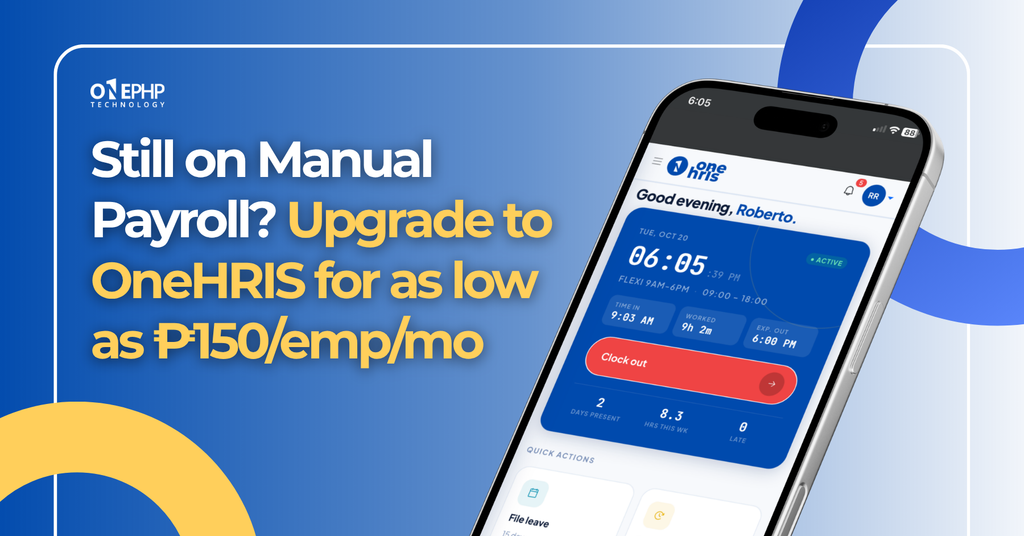
- Pricing is simple. Per-employee pricing in pesos, as low as ₱150/employee/month (excluding VAT).
Is It Time to Switch?
Here are a few signs it’s time to move on from manual payroll:
- Payroll takes your team more than a day or two every cut-off.
- You’ve had to correct and re-release payslips.
- You’re not sure your contribution tables and tax computations are up to date.
- You’re adding employees, branches, or companies, and your spreadsheets are getting harder to manage.
If two or more sound like you, payroll software will probably save you more than it costs.
Final Thoughts
Manual payroll costs you time and money, even if it never shows up as a line item. Payroll software built for the Philippines gives you accurate computations, up-to-date compliance, and time back for the work that matters.
Want to see what fits your business? Find your plan with OneHRIS today.
Have questions or want to learn more? Book a meeting with us!
OneHRIS is built by One Php Technology, a Philippine technology company focused on practical software for local businesses.