In local retail, distribution, e-commerce, and manufacturing, operational efficiency is your best asset. Yet, many growing enterprises still manage millions of pesos in inventory using outdated tools. They rely on Excel sheets, manual logbooks, and paper picking slips. Upgrading your operations to a modern Warehouse Management System Philippines platform replaces these manual bottlenecks with automated accuracy.
When operations slow down, orders face delays. You might also notice stock discrepancies. Often, managers try to fix this by hiring more floor staff. Others rent more floor space. However, the root cause is rarely a lack of space or manpower. Instead, information bottlenecks cause the issue. Many business owners hesitate to adopt modern technology due to common myths. They believe system upgrades are too complex, too expensive, or unnecessary for their current scale.
Below, we dismantle the five most common myths holding local businesses back. We show how a dedicated Warehouse Management System Philippines setup transforms chaos into structured growth.
Myth 1: “A Warehouse Management System Philippines is only for massive logistics conglomerates.”
Many people believe a dedicated WMS is a luxury. They think only multi-national logistics giants, massive third-party logistics (3PL) providers, or conglomerates with huge warehouses need it. Smaller enterprises often assume their current scale does not justify the investment.
In reality, small businesses benefit immediately. Even if you have one warehouse and 50 Stock Keeping Units (SKUs), a Warehouse Management System Philippines solution brings a massive return on investment.
For a local SME, inventory represents their largest tied-up asset. When you have a smaller footprint, space optimization and inventory accuracy become even more critical. A giant conglomerate can afford to lose 1% of its inventory to shrinkage. For a growing distributor or retail brand, that same 1% loss can wipe out their entire monthly profit.
Without an automated system, smaller warehouses suffer from:
- Poor Space Utilization: Staff place products wherever they find open floor space. They do not organize items by sales velocity, weight, or expiration dates.
- Over-reliance on Staff Memory: Operations depend entirely on the memory of one or two veteran warehouse workers. If they call in sick, operations grind to a halt.
- Inability to Add SKUs: The business cannot introduce new product lines. The manual system cannot handle the extra tracking.
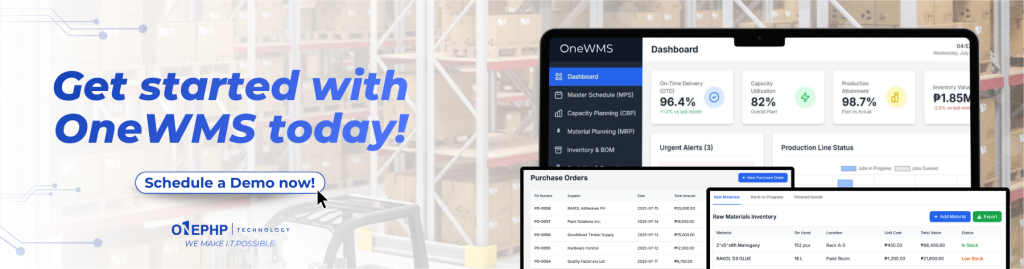
A modern platform like OneWMS scales down easily. It gives growing businesses the exact same structural discipline used by global giants. You can optimize storage racks, set up clear zone picking, and manage more SKUs without hiring more administrators.
Myth 2: “Our current system (Excel and paper) works just fine.”
“If it isn’t broken, don’t fix it.” Many operations managers point to their spreadsheets, whiteboards, and logbooks as proof of success. Because orders eventually leave the warehouse, they deem the manual workflow “good enough.”
However, manual systems do not work fine. They simply hide expensive operational leaks behind a familiar routine. The moment your business experiences a spike in sales—like double-digit mega-campaigns or holiday rushes—the paper-and-spreadsheet setup fails. According to global logistics research on warehouse performance benchmarks by the Warehousing Education and Research Council (WERC), manual tracking consistently ranks as the leading cause of fulfillment delays worldwide.
Relying on Excel and paper hurts your business in several ways:
- The “Ghost Inventory” Trap: Excel is a historic record, not a real-time tool. When a picker takes a box off a shelf, they do not update the spreadsheet instantly. They must walk to the office and write it down. Then, an encoder updates the file at the end of the shift. This long delay creates “ghost stocks.” These are items that appear available on screen but are physically gone, leading to double-selling.
- Human Entry Errors: Human data entry has an average error rate of 1% to 3%. In a warehouse handling 10,000 units a week, that means 100 to 300 errors. A single wrong digit can send perishable goods to the back of the room. They sit unnoticed until they expire.
- Slow Picking Routes: Without system-generated picking routes, workers walk back and forth inefficiently. They cross the same aisle multiple times for a single order. This increases fulfillment times and tire out your staff.
Transitioning to an automated Warehouse Management System Philippines platform replaces human guesswork with barcode and RFID validation. Workers scan and verify every movement instantly. This keeps your inventory accuracy at 99.9%.
Myth 3: “A Warehouse Management System Philippines takes months to implement and disrupts daily operations.”
Decision-makers often dread software rollouts. They expect endless IT consultations, months of downtime, missed shipments, and angry customers. The fear of transition chaos keeps businesses locked into old bottlenecks.
The era of rigid, multi-month software installations is over. Modern, agile systems allow rapid deployment with minimal disruption to your daily work.
With a structured deployment strategy, a robust WMS can go live within weeks. The transition does not require pausing your business. Instead, it occurs in highly controlled phases:
- System Configuration: While your warehouse runs on its legacy setup, we build the core database. We define user roles and clean your product data in the background.
- Pilot Testing: We select a single high-volume zone or a specific product category for a pilot run. This allows your team to test scanners, label printing, and software routing without affecting the rest of the warehouse.
- On-the-Floor Training: We avoid dry classroom lectures. Instead, teams undergo hands-on training on the actual warehouse floor. Because modern interfaces mirror physical movements, pickers grasp the digital workflows in just a few days.
- Phased Go-Live: Once the pilot succeeds, we transition the remaining zones systematically. We often do this during off-peak hours to ensure zero operational downtime.
Our engineering team at OnePHP Technology prioritizes seamless integration. We align the software with your physical layout to support your team from day one.
Myth 4: “A customized platform is far too expensive for our budget.”
When business owners look at customized software, they focus on the upfront cost. They categorize software as a pure expense that drains cash flow without bringing in revenue.
However, a WMS is a high-yield investment. It directly improves your bottom-line profitability. Failing to automate actually costs far more than the system itself.
To understand your true return on investment, you must calculate your current Cost of Inefficiency (COI):
- Picking and Packing Errors: These mistakes lead to return shipping costs, extra labor, and lost customers. A WMS uses barcode verification to stop pickers from packing the wrong SKU. This reduces errors to near zero.
- Shrinkage and Expirations: Untracked expiration dates lead to wasted stock. An automated system directs pickers to the oldest batch first.
- Labor Overtime: Slow, manual searches and paper updates cause overtime during peak seasons. Under a system, pickers follow optimized paths. This doubles their hourly output.
- Excess Safety Stock: Businesses keep extra capital tied up in “just in case” inventory because they do not trust their stock counts. High real-time accuracy reduces the need for expensive safety stock.
Most enterprises using a tailored Warehouse Management System Philippines setup see complete payback within 6 to 12 months. The system rapidly pays for itself by eliminating human error, maximizing your space, and accelerating order cycles.
Myth 5: “Our warehouse floor staff won’t be able to adapt to new technology.”
There is a common worry about warehouse personnel. Managers fear that workers with varying levels of digital literacy will reject a digital platform. They worry that tablets and mobile scanners will lead to confusion and drop productivity.
In reality, warehouse staff do not reject technology. They reject badly designed technology.
If a system features complex menus, confusing jargon, and English-only technical phrases, floor staff will naturally bypass it to save time. However, a system built for the end-user gets a completely different reaction.
Modern localized systems focus on the daily realities of local warehouse operations:
- Filipino-Friendly Interfaces: A localized UI simplifies complex terminology into clear, everyday language. It uses visual icons and color-coded statuses (like Green for completed and Red for errors).
- Action-Oriented Workflows: The system mirrors the natural physical steps of a worker. Instead of typing data, a picker scans a barcode, reads a location number, grabs the item, and confirms with a single tap.
- Empowerment Over Complexity: Warehouse staff quickly support the system when they see it eliminates tedious manual logbooks. It saves them from walking miles of unnecessary steps and protects them from blame for packing errors.
Technology must serve the people on the ground. Providing your team with an accessible tool like OneWMS reduces training time to less than a day. It also builds a culture of precision across your entire warehouse floor.
The Bottom Line: Scalability Requires Structural Integrity
You cannot scale your sales if your backend infrastructure constantly fights fires. Every manual log entry, unverified shipment, and misplaced pallet acts as an anchor. It holds your business back from real expansion.
Transitioning to a dedicated Warehouse Management System Philippines setup is not about replacing your team. It is about equipping your operations with a digital backbone designed for speed, accuracy, and absolute scalability.
Stop letting legacy myths block your operational potential.
Ready to Transform Your Warehouse Operations?
Every business has unique inventory flows, storage challenges, and distribution models. Off-the-shelf software forces you to change your workflows. Your technology should adapt to your business, not the other way around.
Whether you need to eliminate spreadsheet errors, automate expiration tracking, or secure your inventory control, OnePHP Technology develops the scalable, tailored WMS infrastructure your enterprise needs to thrive.
👉 See Our Warehouse Management System Philippines Live — Book Your Demo Today