In the Philippine business landscape of 2026, the definition of “Human Resources” has undergone a radical shift. It is no longer a back-office function relegated to filing paper leaves and printing thermal payslips. Today, HR is about workforce agility.
As local companies solidify their transition toward permanent hybrid setups and decentralized operations, the ability to pivot quickly is the only way to remain competitive. Understanding how a modern HRIS (Human Resource Information System)—specifically one with a robust Philippine Payroll engine—acts as your digital backbone is no longer just a “tech upgrade”; it is essential for survival.
Relying on manual logbooks, physical bundy clocks, and fragmented Excel sheets is no longer a viable strategy for growth. In an era where speed is currency, “Administrative Drag” is the silent killer of the Filipino enterprise.
1. The Problem: The “Fragmented HR” Trap
Most growing businesses in the Philippines suffer from scattered data. When your information exists in silos, your leadership is essentially flying blind. Consider the typical “Fragmented HR” workflow:
- Time & Attendance is captured on a physical logbook or a standalone biometric machine.
- Leave Credits are tracked in a separate folder by an HR officer.
- Payroll is a grueling 3-day marathon involving VLOOKUPs and manual tax computations.
This fragmentation leads to Administrative Drag—the measurable slowdown of a company due to inefficient internal processes.
The Local Compliance Barrier
A common mistake Filipino firms make is adopting global HR software that lacks a localized layer. While “Silicon Valley” software looks sleek, it often fails to account for the specific nuances of the Department of Labor and Employment (DOLE) regulations.
Without a localized system, you risk significant human error in:
- Complex Pay Rules: Night differentials, overtime on rest days, and varying holiday pay (Regular vs. Special Non-Working).
- The 13th-Month “Annualization”: Calculating the correct tax annualization for the 13th-month pay is a nightmare in a spreadsheet but a click of a button in a localized HRIS.
- Government Remittances: Ensuring SSS, PhilHealth, and Pag-IBIG contributions reflect the latest 2026 contribution tables.
2. What is OneHRIS? (The Localized Digital Backbone)
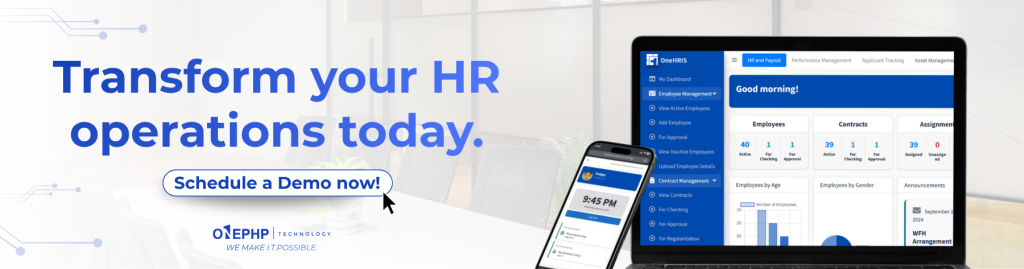
At OnePHP Technology, we recognized that Filipino business owners didn’t need just another software; they needed a solution that understood the local heartbeat. We developed OneHRIS to turn your HR department into a high-speed engine for growth.
OneHRIS is an integrated system specifically engineered for the Philippine regulatory and cultural environment. It centralizes every employee touchpoint—from the moment an employee is onboarded to their final offboarding. This creates the “structured organization” required to manage human capital effectively in a high-growth market.
3. Deep Dive: Key Features of HRIS Philippine Payroll
To truly understand how OneHRIS functions as a backbone, we must look at the four pillars of its architecture:
A. Automated Government Compliance
The burden of manual reporting is the biggest time-sink for Filipino HR. OneHRIS automatically generates the required reports for statutory contributions. By pulling data directly from the payroll module, it eliminates the “copy-paste” errors that lead to penalties and unhappy employees.
B. Real-Time Attendance & Geo-Fencing
The workforce of 2026 is mobile. Whether your team is at a satellite office in Mandaluyong, a warehouse in Laguna, or working from home in Cebu, OneHRIS keeps the pulse.
- Mobile-First Clock-ins: Employees use their smartphones to check in.
- Geo-Fencing: You can set “virtual boundaries,” ensuring employees can only clock in when they are actually at their designated job site.
C. Employee Self-Service (ESS)
Nothing slows down an HR manager more than manual inquiries. The OneHRIS ESS portal empowers your staff to view payslips and file leaves via their smartphones. This reduces the administrative burden on your HR team by up to 60%, a goal often highlighted in Gartner’s research on digital transformation.
D. Advanced Analytics for Leadership
In 2026, data is the new oil. OneHRIS provides dashboards that show turnover rates, absenteeism trends, and labor cost distribution. You can finally see exactly where your manpower budget is going.
4. Driving Workforce Scalability
Scaling a business isn’t just about hiring more people; it’s about having the infrastructure to manage them efficiently. According to Gartner, automating administrative tasks is the number one way to improve employee retention.
Why? Because employees in 2026 expect transparency. They want to be paid on time and see their tax breakdown without a paper trail. Efficiency is a recruitment tool; top talent in the Philippines now looks at a company’s “Tech Stack” as a sign of professional stability.
5. The OnePHP Promise: We Make I.T. Possible
The era of the “Administrative HR” is officially over. To compete and win in 2026, you need a Strategic HR function. OneHRIS removes the blindfold of manual tracking and gives you total visibility over your workforce.
Your Transformation Roadmap
Transitioning to OneHRIS isn’t just about software; it’s about a partnership. Our Solutions Team works with you to:
- Audit your current manual processes.
- Migrate your data into a secure environment.
- Train your team to use the dashboard.
- Scale as your business adds more branches.
Stop Fighting with Spreadsheets—Start Leading Your People. Experience a secure, scalable, and Philippine-ready foundation for your company’s most valuable asset.
📞 Contact our Solutions Team today for a personalized OneHRIS Demo!
🌐 Explore our HR Solutions to learn more.